Sunday, October 6, 2013

Wheat Watch: Season 3 Episode 1 - Wheat Drill Edition

We are almost done planting all of our wheat.  We thought we were going to be planting into dust like we did last year but we actually got a decent amount of RAIN.  The fields were too wet for us to plant for a little over a week after the rain.  I've never experienced this type of delay before.  I can't say that I was very upset about it though. 

The implements we use to plant wheat and other grains are called drills. 


Depending on where you are from you might have an image like below in your head when you hear the word drill.  The drills we use to plant wheat are actually 30 to 40 feet wide and hold anywhere from 50 to 100 bushels of wheat for planting.  There are two different types of drills that we use to plant our wheat; the disc drill and the hoe drill.


The below disc drill uses two discs to open the soil so the seeds and fertilizer can be dropped in.  After the seed is dropped in a press wheel covers the seed up with soil and packs it into the ground.  This type of drill is best used in a field that has little to no tillage because plant residue from the previous season will not get hung up in the planting process.


The below hoe drill uses a shank with a point on the end that splits open the soil.  The seed, fertilizer and press wheel all work in the same fashion as the disc drill.  In order to plant effectively with a hoe drill the field must be tilled and have little to no plant life or residue.  If there is too much residue it will get caught in front of the shank causing the drill to not plant correctly. 


I planted wheat with both types of drills and they both have their advantages and disadvantages.  The condition of the field, the farming practices used over the previous seasons, and moisture in the soil all help us to determine which type of drill we use. 

Below is one of the first fields we planted and the wheat is looking great.


The other day I heard a farmer say "Getting that rain sure makes me look like a better farmer..."  It's amazing to me how true that is.

-Drill Instructor Ryan

Friday, September 13, 2013

Unknown Substance

Farmer's Log - FarmDate - 13-9-2013

We have encountered a weather event unknown to this area. There is a mysterious substance that has fallen from the sky for the last 2.5 days.  The local population has had issues with transportation as well as communication.  Despite this, they have reached a state of euphoria.  Further investigation will need to take place in order to identify the exact nature of the substance and what caused this weather event.


-Farmer Ryan

Tuesday, September 10, 2013

OH HAIL NO!

Well the weather threw us another corn curveball; we got hit with hail on some of our irrigated corn.  Hail is bad for a lot of reasons but the main one is that it destroys the leafs ability to harvest energy from the sun.


It might be hard to appreciate just how bad the hailed corn looks, so below is a picture of one of our healthy corn fields.


A couple weeks after the corn was hit by hail I went back to look at the ears of corn.  Below is an example of a corn ear "tipping back".  Tipping back is when the corn plant aborts some of the kernels of corn because it doesn't have the energy to sustain all the kernels on the ear.  Typically a farmer looks for some tipping back because it shows that the population of corn plants in the field is correct.  In the below example, more kernels were aborted than normal because of the hail damage. 


Hail also directly damages the ears of corn.  You can see below where a piece of hail actually hit the ear and destroyed some of the kernels in the ear of corn.  A secondary problem that occurs is that the damaged kernels begin to rot and will rot out the rest of the ears of corn.


Every year the seed corn companies develop corn that has a resistance to a pest or a disease.  I told my father in law that maybe we should look into hail resistant corn next year...

-Hail Hater Ryan

Sunday, September 1, 2013

Deep Pockets

Before I commute to work walk outside the house, I fill my pockets with stuff that will help me get through my day of farming.  Below is a list of the items I typically keep in my pockets:


1.  Cell Phone -  I use this for the obvious stuff like phone calls, texts, and emails.  It comes in handy when I want to obsessively check the commodity markets or the weather.  I also have a flashlight app that is useful when I'm working tractors, trucks, or whatever. 

2.  iPod and Headphones - I use these when I spend a lot of time on a tractor.  I also use my ear buds as ear plugs when I am working on loud equipment.

3.  Grid Paper Moleskin and Pen - This is where I take notes if I learn something new.  So as you can guess this book obviously fills up fast.  If I need to fabricate something, I use it to draw out plans before I get started.  The only problem is that the years of IT have made my penmanship look like something like cursive hieroglyphics. 

4.  Pliers - I use these pretty much every day to tighten and loosen nuts, bolts, hoses, etc... I use them as a hammer a little bit too often, which is something I've had to get used to on the farm.  In IT it's never a good idea to hit something in order to fix it.  When you're working on the farm it is pretty much always is a good idea.  Even if hitting it doesn't fix the problem it at least it makes you feel better.

5.  6 - Way Screwdriver -  I'm the only one on the farm that actually carries a screwdriver with me at all times but I use it everyday.  It comes in handy when I test our electric cattle fences, and if I need to hot wire a tractor.

6.  Box Cutter Knife - I would like to say that I carry a nice pocket knife around with me, but how much these tools fall out of my pocket it's just not worth it.

7.  Work Gloves -  I wear these when its really cold or really hot.  My tools sitting in a black tool box on 100 plus degree days (who's dumb enough to paint their toolbox black?) get pretty hot. 

8.  Safety Glasses - I use these when I'm working on things that could blow up in my face, literally.  Most of the time though I just use them for sunglasses.

9.  Farm Hat -  We get these for free from the companies we buy seed, chemicals, and farm equipment.  By free I mean they are the most expensive hats we will ever buy.

-Swiss Army Pants Ryan

Saturday, August 3, 2013

Wheat Watch Season 2 Harvest Edition

It's been kind of hard to get excited about writing about wheat harvest this year because most of the wheat we planted failed; the drought killed it.  I know, blah, blah, blah you are sick about hearing about the drought.  Frankly, I'm sick of writing about it.  I have asked around to see if it really does rain in Western Kansas, and I was assured that it does.  I guess I've just been lucky enough to get started in the dry years.


The irrigated fields we harvested were not as good as most years even thought they had the moisture and fertilizer they needed.  They were impacted by two freezes within a week of each other.  The freezes occurred when the growing point of the wheat was out of the ground.  The growing point is the part of the wheat plant that turns into the wheat head that produces the wheat kernels.  These freezes caused the wheat to bronze which as you can see below basically means it turned the wheat a brown/bronze color.  You can think of it as freezer burn for wheat


We only had one dry land field that made it to the harvest stage of the wheat growth cycle.  It got a couple inches of rain that the rest of our wheat missed out on.  It ended up making about a quarter of what our wheat made last year, but at least we had something to harvest.


Even thought its been another disappointing harvest, there is always next season and next year.

-Aspiring Optimistic Farmer Ryan

Saturday, July 27, 2013

Let'er RIP

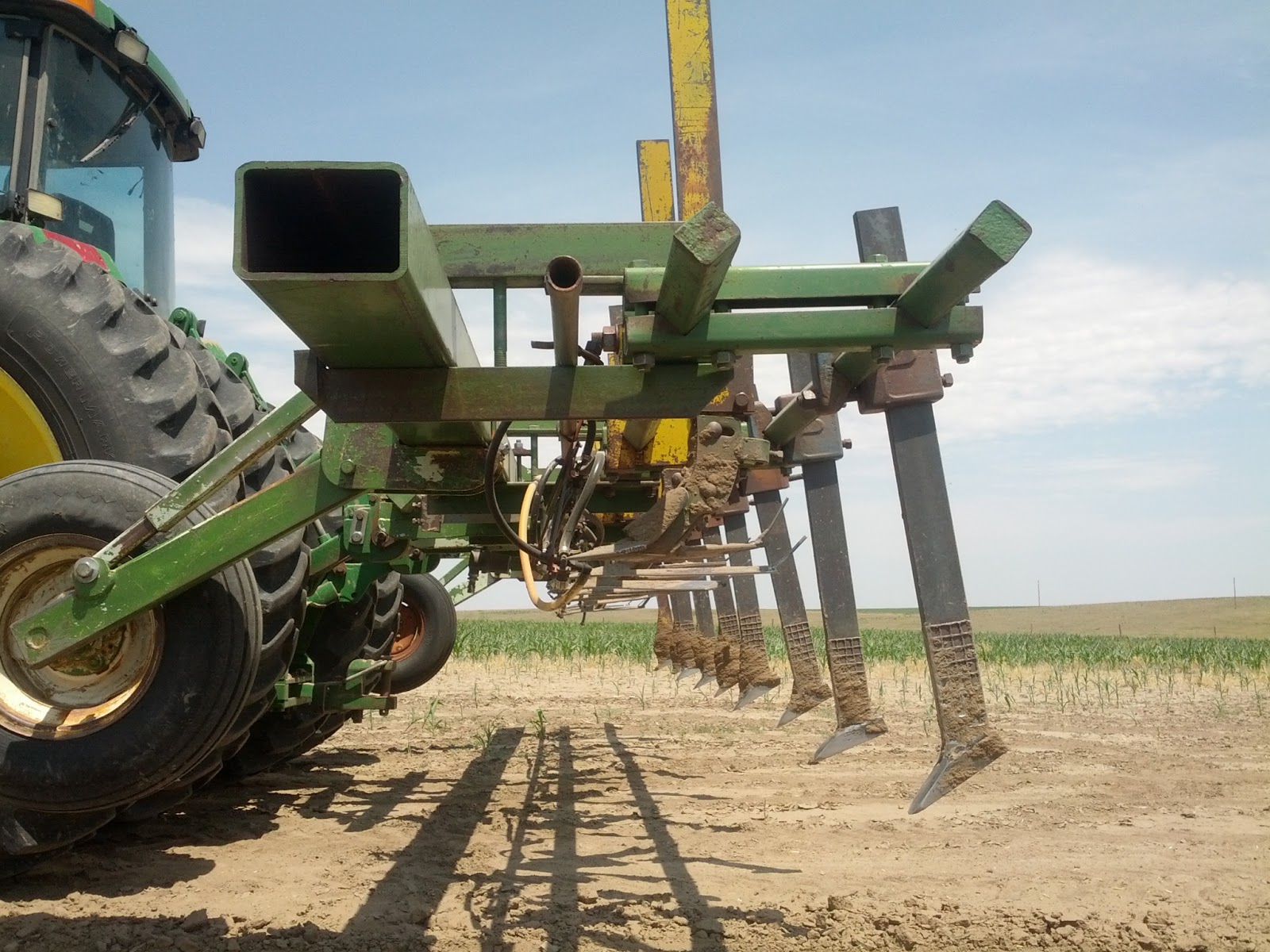
After we plant our corn there is another step we like to complete on our irrigated fields before turning the sprinklers and making it rain the rest of the season.  After the corn has grown to about the v4 stage (four leaves on the plant) of corn growth we like to rip the soil.  We use the below implement called a "ripper" for this operation.  His name is Jack.


There are actually two things that can be done with this ripper: it can cultivate, and it can rip.  Cultivating is when you use the arrowhead shaped blades, called sweeps, to cut the roots of any weeds that are growing between the rows of corn. 


This is very useful for volunteer corn which doesn't get killed when we spray for weeds in the fields.  This is because the corn that we grow is roundup ready, so the next year's volunteer corn is also roundup ready and resistant to the chemicals we spray.   Below is a bunch of volunteer corn that is a good example of why we have to cultivate some of our irrigated fields.  Corn requires a lot of care in order to produce the amount of grain it does.  If we were to have let this volunteer corn grow it would have not produced hardly any corn and it would have sapped the water nutrients and light from the corn that we planted this May.


When we rip we just use the bars with barbs on them, called ripper shanks, to fracture the subsoil and allow water to more easily flow into the soil.  This allows our corn to get more of the moisture it needs to produce the maximum amount of corn. 


Once again I got to use my Russian Satellite corrected guidance system.  We were able to use the guidance lines that we created when we planted our corn and modified them to work with our ripper.  This allowed me to rip and cultivate at much faster speed and have much more accuracy.  Not to harp on a subject, but why don't we have better satellites than the Russians.  I mean, what happened to us winning the space race?

-Ryan and Jack the Rippers

Tuesday, July 9, 2013

Corn Cam Season 2 Episode1: Planting

For most of May we were planting corn like crazy.   We had a lot of acres to plant in a short amount of time, mostly because of weather delays (including snow in May... bleh).


We have a 16 row corn planter that we use for all of our irrigated fields, but it wouldn't have been enough to get all of our of our dry land corn planted in time so we decided to get two tractors rolling.  We didn't have a second 16 row planter, but we did have 2, 8 row planters.  So my father-in-law and I did some "farm engineering" and now we have a second 16 row planter.  Having two different planters pulled by one tractor can have its difficulties, but we were able to plant a lot of acres with that setup and our fields are looking great.


We bought a tractor last December and set it up with a new guidance system.  We hadn't really had a chance to try it out until we started to plant corn, and it was a lot of fun to finally get to use it.  Something that I thought was interesting about this system is that it uses Russian positioning satellites to improve the accuracy of the system.

Can you imagine the response I would get if I traveled back in time to the cold war era and told a farmer that I had a tractor that drove itself and that it used Russian satellites to help steer... ?


-Planter Man Ryan