Well I drove the semi on the road for the first time last week. I know. My father-in-law is Brave. I have to admit it was a lot different than I though it would be.
The weirdest thing to me is that you don't use the clutch to shift through the gears after 1st gear. Then the second weirdest thing is that there are two ranges of gears. The 2nd, 3rd, 4th, and 5th turn into the 6th, 7th, and 8th and 9th gears all with a flip of a switch on the side of the shifter. So when you have a loaded down trailer you have to shift a ton to get the semi up to speed. If you don't have anything on the trailer, you can throw it into 6th gear and go from there. I have to admit I haven't been able to get this to work. Yet.
In the below picture I've circled the switch on the side of the shifter.
I'm not going to say that the semi was a sports car but when you give it some diesel you feel the acceleration.
-Trucker Ryan
P.S. Maybe now I'll become an Ice Road Trucker...
Sunday, October 14, 2012
Tuesday, October 2, 2012
Wheat Watch - Season 2 - Episode 1 - THE PLANTING
We finished planting our irrigated wheat circles a couple of weeks ago. We've started to plant our dry land acres and we are about half way done. The ground is so dry that we are not able to get the wheat seed to moisture, so at this point we are doing what I like to call: A plant and pray mission. We are planting wheat and praying for rain.
Below is a picture of us planting wheat in one of our irrigated circles. In the background you can see another tractor. After we harvested our wheat last June we ran our disc (basically a huge tilling implement) through the circle. We ran it through again a second time before we planted and when we went to plant we realized that the ground was too loose to plant the wheat. In order to resolve this issue we ran a packer over the ground to pack the dirt and make the ground nice and flat for when we planted.
In the below picture I'm trying to finish the circle so that we could let the sprinkler run over the freshly planted wheat.
As soon as we planted the circle we started the sprinkler up and we've been running it ever since. Below is about one week of growth:
Below is about three weeks of growth:
It was funny to me when I started filling the wheat drill for the first time. We did a bunch of work to get the wheat out of the field and now we are doing a lot of work to put it back in. It's like the Lion King's circle of life, but for farmers. (Queue the Lion King theme song)
-Farmer Ryan
Below is a picture of us planting wheat in one of our irrigated circles. In the background you can see another tractor. After we harvested our wheat last June we ran our disc (basically a huge tilling implement) through the circle. We ran it through again a second time before we planted and when we went to plant we realized that the ground was too loose to plant the wheat. In order to resolve this issue we ran a packer over the ground to pack the dirt and make the ground nice and flat for when we planted.
On the irrigated land we planted about two bushels (120 pounds) of wheat per acre. So I spent just about half of my time filling the drill and the other half planting.
Below is about three weeks of growth:
It was funny to me when I started filling the wheat drill for the first time. We did a bunch of work to get the wheat out of the field and now we are doing a lot of work to put it back in. It's like the Lion King's circle of life, but for farmers. (Queue the Lion King theme song)
-Farmer Ryan
Friday, September 14, 2012
What do Professional Athletes, Rappers, and Farmers have in common?
We make it RAIN! Although farmers don't use dollar bills they use center pivot irrigation systems. In Western Kansas you will hear these systems called a lot of different things: pivots, sprinklers, circles, etc...
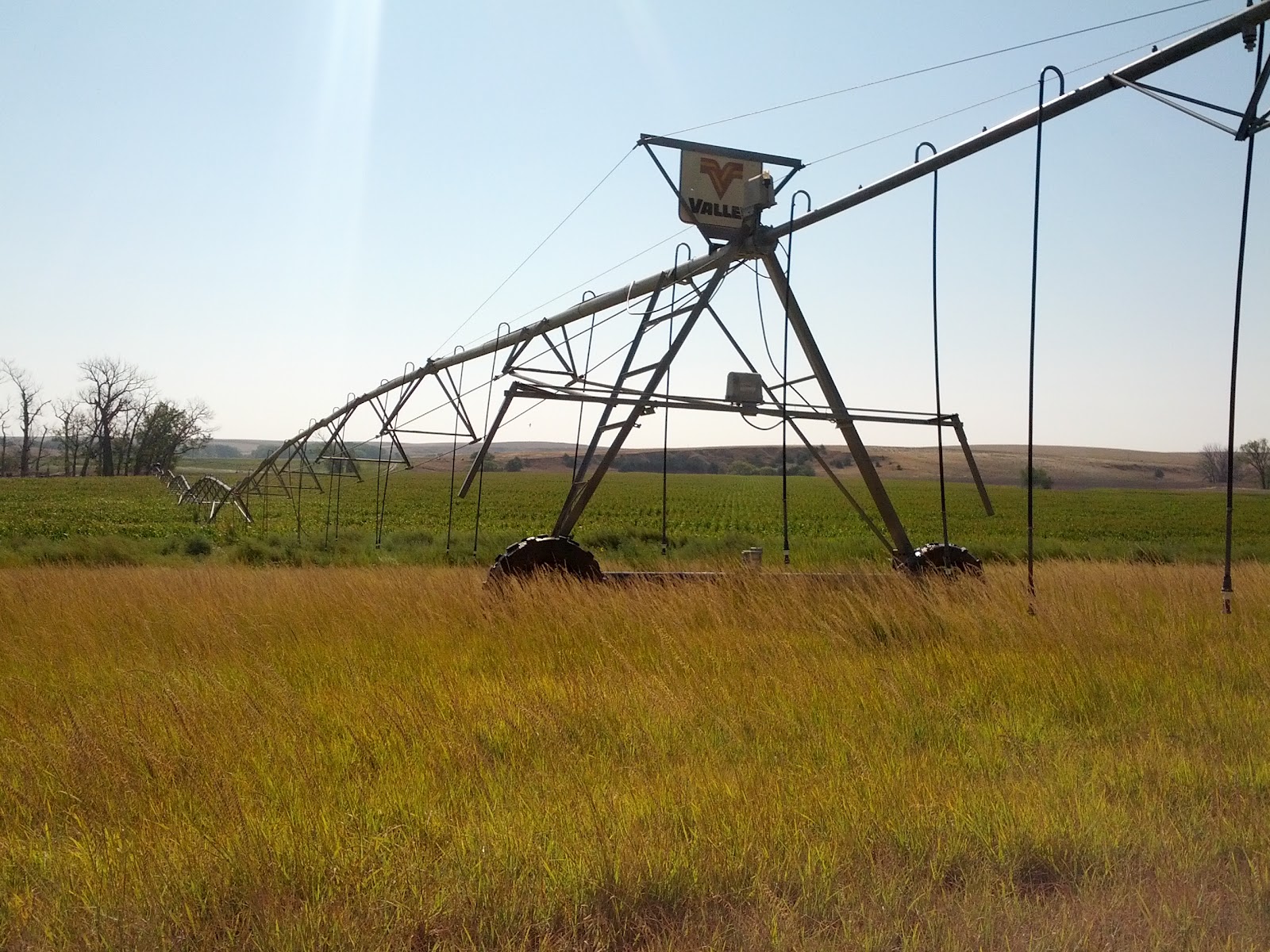
I discussed our irrigation wells in one of my previous posts, but the wells are only half of the irrigation equation. After the water is pumped out of the ground it has to be delivered to the crops. We do this by using sprinkler systems.
Most of our sprinklers have anywhere from 6 to 10 sections. Each section has a tower with a control box, cabling, and a section of pipe with hoses and nozzles dropping down. Below is a picture of the bottom half of a sprinkler tower. I have circled the electric motor that moves the tower section. All of our sprinklers use 480 volt three phase electricity to power the electric motors that move the sprinkler towers. The electric motors have two drive shafts on either side attached to gearboxes which turn the wheels of the sprinkler.
One of my first projects on the farm was stripping all the wires out of sprinkler control boxes and completely rewiring them. In the below picture there is an example of a control box. I rewired 8 of these for one of our new sprinklers. It was kind of like hooking up a new TV and surround sound 8 times except that I didn't get to watch a movie afterwards... I'd like to report that after rewiring all the control
boxes and hooking them all up. The sprinkler ran like a champ the first
time we fired it up.
This season we setup three new sprinkler systems all during one of the hottest and driest years on record. We had an irrigation contractor leave us high and dry (pun absolutely intended) with some of the wiring and underground work that needed to be done but we were still able to get them setup in time. This year some of our best corn is growing under the new sprinklers.
Being a farmer has changed my perspective on a lot of things. I never really though it would change my perspective from 30,000 feet though. Now when I fly over farmland I spend my time checking out other farmers' circles: "That circle is HUGE! That guy has four 1 section sprinklers right next to each other; he must have great water."
Wow. Who am I?
-Rain Maker Ryan
I discussed our irrigation wells in one of my previous posts, but the wells are only half of the irrigation equation. After the water is pumped out of the ground it has to be delivered to the crops. We do this by using sprinkler systems.
Most of our sprinklers have anywhere from 6 to 10 sections. Each section has a tower with a control box, cabling, and a section of pipe with hoses and nozzles dropping down. Below is a picture of the bottom half of a sprinkler tower. I have circled the electric motor that moves the tower section. All of our sprinklers use 480 volt three phase electricity to power the electric motors that move the sprinkler towers. The electric motors have two drive shafts on either side attached to gearboxes which turn the wheels of the sprinkler.
This season we setup three new sprinkler systems all during one of the hottest and driest years on record. We had an irrigation contractor leave us high and dry (pun absolutely intended) with some of the wiring and underground work that needed to be done but we were still able to get them setup in time. This year some of our best corn is growing under the new sprinklers.
Being a farmer has changed my perspective on a lot of things. I never really though it would change my perspective from 30,000 feet though. Now when I fly over farmland I spend my time checking out other farmers' circles: "That circle is HUGE! That guy has four 1 section sprinklers right next to each other; he must have great water."
Wow. Who am I?
-Rain Maker Ryan
Tuesday, August 28, 2012
Corn Cam Part IV
The Corn has reached the R5 stage of corn development. The ears of corn have fully formed and some of the kernels have developed dents.
We had to call in Air Support to spray our corn for the second time this year. Our corn is being attacked by spider mites, which eat away at the leaves of the corn plant. I actually snapped a pretty cool picture of the crop duster. I think he is about a foot off the top of the corn.
It's pretty fun to watch these planes spray the fields. They fly under power lines, dodge sprinklers, and fly about 1 to 5 feet above the corn.
-Farmer Ryan
Dent corn or "field corn" is the majority of corn that is grown here in
Western Kansas. It is used to feed livestock, create ethanol, and high
fructose corn syrup. Dent corn is not like the corn you get from the
farmers market and eat off the cob. If you were to try to boil this
corn and eat it you would regret it, because it only has about 1/5 of
the sugars that are found in sweet corn and it is high in starches.

We had to call in Air Support to spray our corn for the second time this year. Our corn is being attacked by spider mites, which eat away at the leaves of the corn plant. I actually snapped a pretty cool picture of the crop duster. I think he is about a foot off the top of the corn.
It's pretty fun to watch these planes spray the fields. They fly under power lines, dodge sprinklers, and fly about 1 to 5 feet above the corn.
-Farmer Ryan
Thursday, August 9, 2012
Well, Well, Well
The person that is usually in charge of checking our irrigation wells just went on vacation. So for the next couple of weeks I'm going to be checking all of our wells. We have several different types of well engines, and motors and they are all over the place. Below are some examples of our natural gas well engines. All the engines we use are all big block Chevy's that have been modified to run on natural gas. These engines pull the water from the well and they also generate three phase electricity. The electricity is used to power the center pivot sprinkler systems. It will take an entire blog post to explain sprinklers so you'll have to stay tuned.
Below are some examples of electric well motors. The electric motors run on three phase electricity. There are two ways to get three phase electricity; 1. Have three phase ran to the location of your well (this can get EXPENSIVE) 2. Setup what a RotoPhase to generate three phase out of standard electricity.
Every morning I go out and check each well to verify it is up and running. I also check the well engines to verify that they have the correct amount of motor oil, check the water pressure on the water coming up from the well and I check that the drip oil is dripping at the correct rate. Drip oil is oil that is "dripped" down the well shaft and it keeps the well shaft lubricated.
There are times when I pull up that the wells are not running. That's when the troubleshooting starts. Most of the time the wells have been shut down by the safety switches on the Sprinklers. The sprinkler systems are wired to shut down if they get out of alignment. There a lot of other things that can cause these well motors to shut down. So every time I pull up to a well that isn't running I know its going to be an adventure.
I had a person ask me how much work it was to run irrigation on our fields. I told her all the things we have to do to keep them running. She said that it sounded like it was as much work as having kids. To which I replied -That makes me not want to have kids... Just kidding Mom... Stop freaking out...
-All's Well Checker Ryan
Below are some examples of electric well motors. The electric motors run on three phase electricity. There are two ways to get three phase electricity; 1. Have three phase ran to the location of your well (this can get EXPENSIVE) 2. Setup what a RotoPhase to generate three phase out of standard electricity.
There are times when I pull up that the wells are not running. That's when the troubleshooting starts. Most of the time the wells have been shut down by the safety switches on the Sprinklers. The sprinkler systems are wired to shut down if they get out of alignment. There a lot of other things that can cause these well motors to shut down. So every time I pull up to a well that isn't running I know its going to be an adventure.
I had a person ask me how much work it was to run irrigation on our fields. I told her all the things we have to do to keep them running. She said that it sounded like it was as much work as having kids. To which I replied -That makes me not want to have kids... Just kidding Mom... Stop freaking out...
-All's Well Checker Ryan
Saturday, August 4, 2012
Corn Cam Part III
Our irrigated corn is plugging away in spite of the heat and it has reached the R1 phase stage of growth. The R1 stage is when the pollination occurs and during this period it is very important to have enough water and cooler temperatures.
The next two pictures show the tassels on the top of the corn plant and the silks coming out of the top of the corn cob. The pollen from the tassels falls down and it pollinates the silks. Once pollination occurs kernels of corn start to form on the corn cob.
Tassels:
As I said in my previous post there are some farmers who are cutting silage out of their dry land corn. The below picture is a silage machine and it is in the process of chopping up some drought stricken corn in a field by our farm. Silage machines have tons of horse power and they offload all of the silage onto a truck. Since there isn't any storage on the silage machines there has to be a steady stream of trucks to keep the silage machine running.
On a positive note the corn prices have risen dramatically in the last couple of months. We are usually done harvesting our corn in November so the futures price that we watch is December corn. If you would like to track the price as well you can use the following symbol @CZ2.
It's pretty fun to watch the price of corn to go up this much, but at this point I'm hoping that our irrigated corn will actually produce some corn to sell.
The next two pictures show the tassels on the top of the corn plant and the silks coming out of the top of the corn cob. The pollen from the tassels falls down and it pollinates the silks. Once pollination occurs kernels of corn start to form on the corn cob.
Tassels:
Silks:
It's pretty fun to watch the price of corn to go up this much, but at this point I'm hoping that our irrigated corn will actually produce some corn to sell.
-Farmer Ryan
Tuesday, July 17, 2012
Corn Cam Part II
We are entering what I have started to call the CORNTASTROPHE phase of 2012. There have been some extreme temperatures; one day during harvest it was 115 degrees outside. We are also about 4 inches behind on moisture for the year. It was so dry during corn planting season that we didn't plant any dry land corn. The below pictures were taken on a neighboring farmer's field.
As you can see this corn isn't going to make it
At this point in time most of the dry land corn in this area is going to be tilled into the ground or cut into silage. Silage is used to feed livestock and essentially is just chopped up plant material. The problem with using this corn as silage is it can be high in nitrates that actually kill cattle. So the dry land corn out here is pretty much a bust.
We do have a decent amount of irrigated corn and I've got some pictures below. The corn is about six feet tall and most of it has reached the V15-17 stage of corn growth. Water is very critical at this stage and we are running our wells as much as possible to keep our corn growing.
The finger looking things coming out of the bottom of the corn plant are called brace roots. They help to pull nutrients from the top layer of soil as well as you guessed it... brace the plant.
Because the drought that is hitting us is actually hitting the corn belt as well, corn prices have risen dramatically in the last month. I heard a report that stated that the USDA has dropped expected average corn yield for the United States by 15% in the last week alone. After driving around North West Kansas I feel like they should have dropped it more than that.
If anyone reading this is taking orders for rain. I would like to put in an order for about 4" of rain over the course of the next week, and then have temperatures of less than 90 degrees until the corn is ready to harvest. Thanks!
-Farmer Ryan
As you can see this corn isn't going to make it
At this point in time most of the dry land corn in this area is going to be tilled into the ground or cut into silage. Silage is used to feed livestock and essentially is just chopped up plant material. The problem with using this corn as silage is it can be high in nitrates that actually kill cattle. So the dry land corn out here is pretty much a bust.
We do have a decent amount of irrigated corn and I've got some pictures below. The corn is about six feet tall and most of it has reached the V15-17 stage of corn growth. Water is very critical at this stage and we are running our wells as much as possible to keep our corn growing.
The finger looking things coming out of the bottom of the corn plant are called brace roots. They help to pull nutrients from the top layer of soil as well as you guessed it... brace the plant.
Because the drought that is hitting us is actually hitting the corn belt as well, corn prices have risen dramatically in the last month. I heard a report that stated that the USDA has dropped expected average corn yield for the United States by 15% in the last week alone. After driving around North West Kansas I feel like they should have dropped it more than that.
If anyone reading this is taking orders for rain. I would like to put in an order for about 4" of rain over the course of the next week, and then have temperatures of less than 90 degrees until the corn is ready to harvest. Thanks!
-Farmer Ryan
Subscribe to:
Posts (Atom)