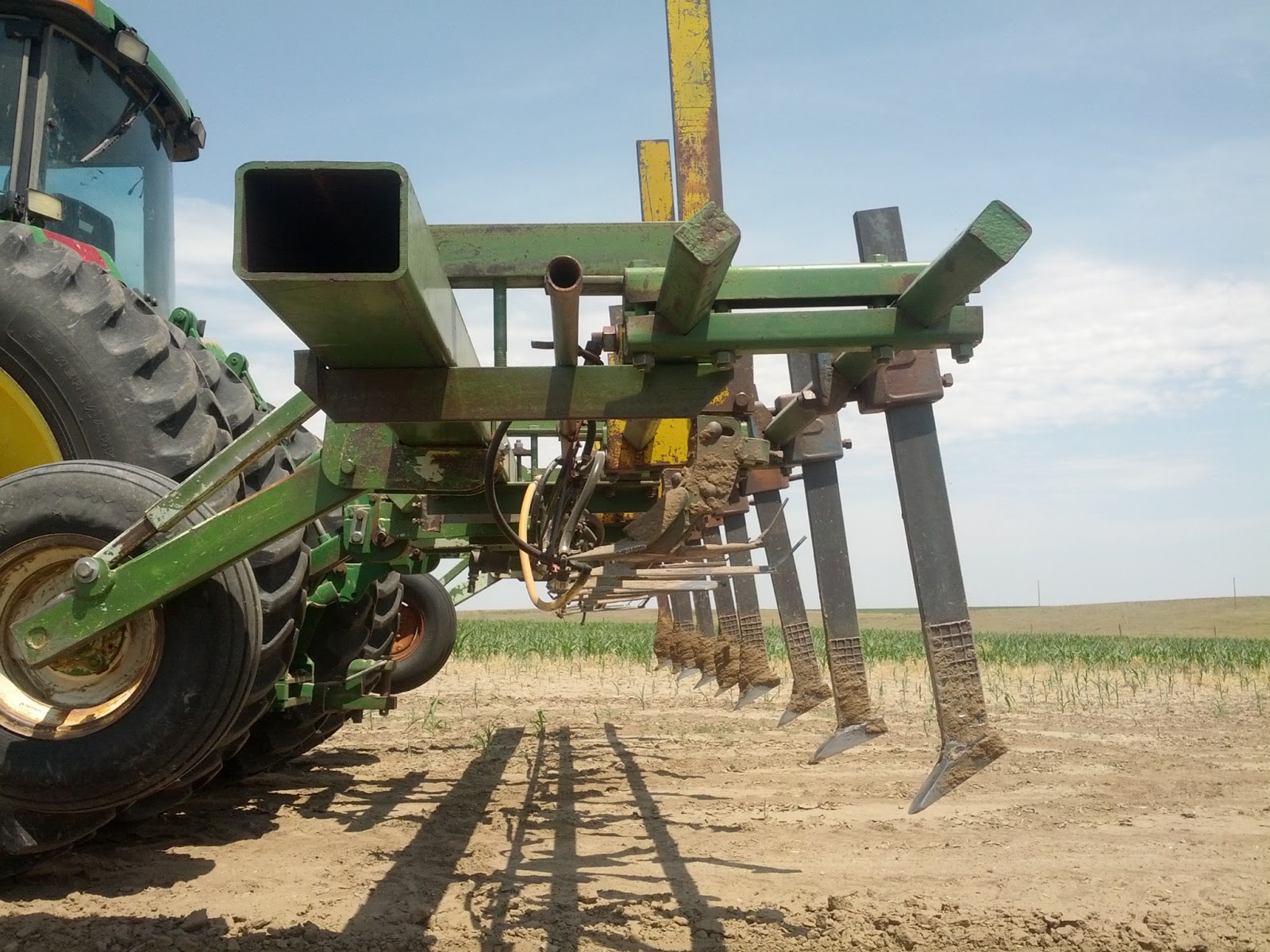
After we plant our corn there is another step we like to complete on our irrigated fields before turning the sprinklers and making it rain the rest of the season. After the corn has grown to about the v4 stage (four leaves on the plant) of corn growth we like to rip the soil. We use the below implement called a "ripper" for this operation. His name is Jack.
There are actually two things that can be done with this ripper: it can cultivate, and it can rip. Cultivating is when you use the arrowhead shaped blades, called sweeps, to cut the roots of any weeds that are growing between the rows of corn.
This is very useful for volunteer corn which doesn't get killed when we spray for weeds in the fields. This is because the corn that we grow is roundup ready, so the next year's volunteer corn is also roundup ready and resistant to the chemicals we spray. Below is a bunch of volunteer corn that is a good example of why we have to cultivate some of our irrigated fields. Corn requires a lot of care in order to produce the amount of grain it does. If we were to have let this volunteer corn grow it would have not produced hardly any corn and it would have sapped the water nutrients and light from the corn that we planted this May.
When we rip we just use the bars with barbs on them, called ripper shanks, to fracture the subsoil and allow water to more easily flow into the soil. This allows our corn to get more of the moisture it needs to produce the maximum amount of corn.
Once again I got to use my Russian Satellite corrected guidance system. We were able to use the guidance lines that we created when we
planted our corn and modified them to work with our ripper. This
allowed me to rip and cultivate at much faster speed and have much more
accuracy. Not to harp on a subject, but why don't we have better satellites than the Russians. I mean, what happened to us winning the space race?
-Ryan and Jack the Rippers
Saturday, July 27, 2013
Tuesday, July 9, 2013
Corn Cam Season 2 Episode1: Planting
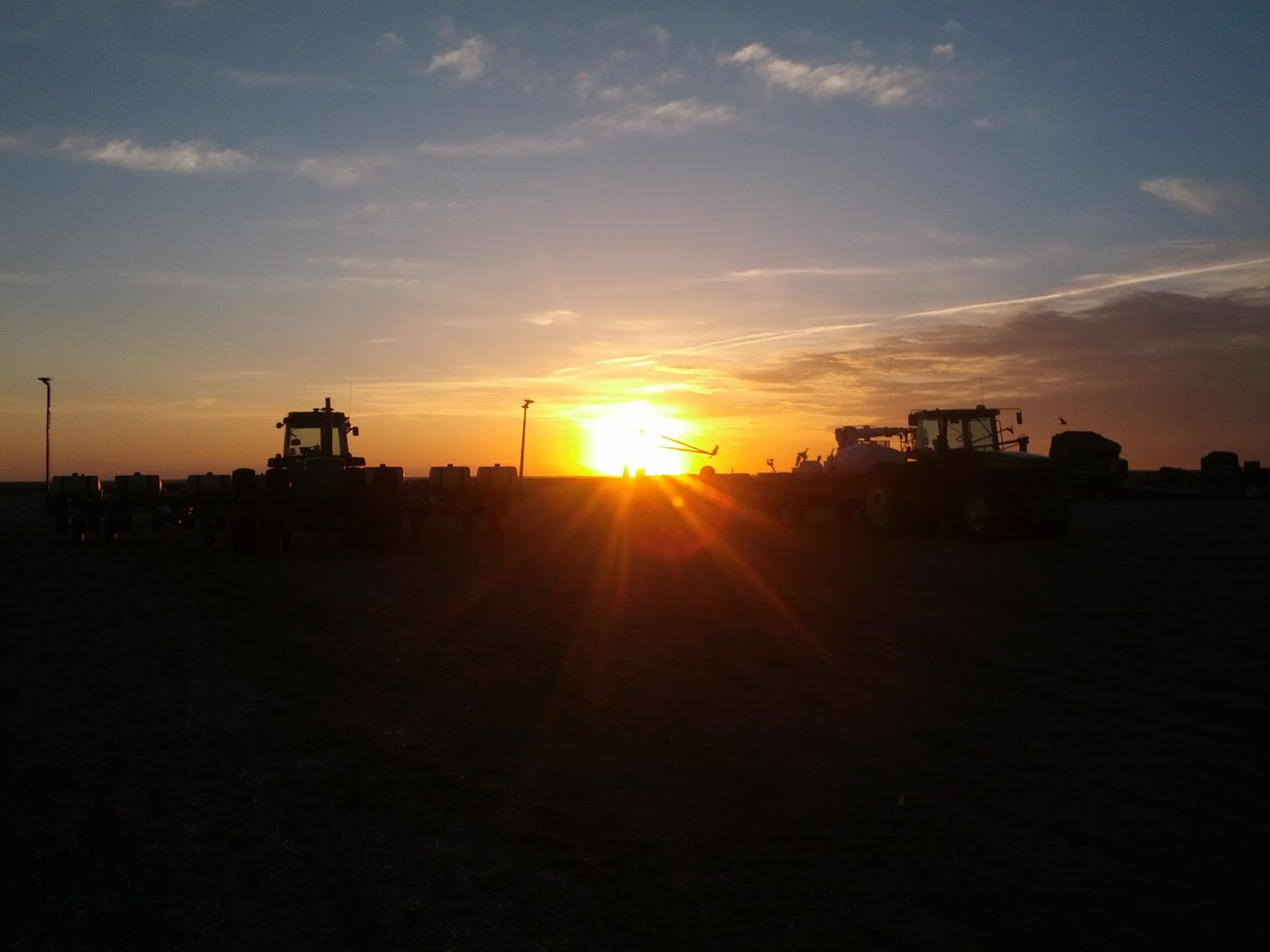
For most of May we were planting corn like crazy. We had a lot of acres to plant in a short amount of time, mostly because of weather delays (including snow in May... bleh).
We have a 16 row corn planter that we use for all of our irrigated fields, but it wouldn't have been enough to get all of our of our dry land corn planted in time so we decided to get two tractors rolling. We didn't have a second 16 row planter, but we did have 2, 8 row planters. So my father-in-law and I did some "farm engineering" and now we have a second 16 row planter. Having two different planters pulled by one tractor can have its difficulties, but we were able to plant a lot of acres with that setup and our fields are looking great.
We bought a tractor last December and set it up with a new guidance system. We hadn't really had a chance to try it out until we started to plant corn, and it was a lot of fun to finally get to use it. Something that I thought was interesting about this system is that it uses Russian positioning satellites to improve the accuracy of the system.
Can you imagine the response I would get if I traveled back in time to the cold war era and told a farmer that I had a tractor that drove itself and that it used Russian satellites to help steer... ?
-Planter Man Ryan
We have a 16 row corn planter that we use for all of our irrigated fields, but it wouldn't have been enough to get all of our of our dry land corn planted in time so we decided to get two tractors rolling. We didn't have a second 16 row planter, but we did have 2, 8 row planters. So my father-in-law and I did some "farm engineering" and now we have a second 16 row planter. Having two different planters pulled by one tractor can have its difficulties, but we were able to plant a lot of acres with that setup and our fields are looking great.
We bought a tractor last December and set it up with a new guidance system. We hadn't really had a chance to try it out until we started to plant corn, and it was a lot of fun to finally get to use it. Something that I thought was interesting about this system is that it uses Russian positioning satellites to improve the accuracy of the system.
Can you imagine the response I would get if I traveled back in time to the cold war era and told a farmer that I had a tractor that drove itself and that it used Russian satellites to help steer... ?
-Planter Man Ryan
Sunday, May 26, 2013
Why Would You Want To Do That?
It's Official. I've sold my house, my wife has quit her job and we've moved all our stuff to Western Kansas. For those of you seeing my blog for the first time, let me fill you in on what's going on. In March of 2012, I moved to my wife's family farm in Western Kansas and since then I've been farming with my father-in-law. You can see my first blog post by clicking here. I wanted to try out farming to see if I liked it enough to uproot my life and transplant to a new location. From the beginning I loved being a farmer. After getting a taste of the freedom that I found on the farm, I don't think it would be easy for me to move back to the city and the IT world.
Why would you want to do that?
I want to farm for a lot of reasons, so many that it's hard to list them all. When I started my blog I hoped that I could try to answer that question. However, if I am forced to try to succinctly state in a few words why I want to farm I'd have to say: excitement, education, and tangibility.
I've realized that in order for something to be exciting there has to be some uncertainty. The fabric of farming is wove with many threads of uncertainty and excitement. It' hard for me to think of anything on the farm that isn't a gamble in one way or another. What to grow, when to plant it, how to harvest, etc... That's not taking into account the weather, which in Western Kansas, is as volatile as commodity markets. Both of which, decide how much money you make or lose in a year as a farmer.
When I was in primary education and even some in college, I had trouble believing that I would ever use the information that was being presented to me in class. On the farm, I've had to dust off all kinds of facts from my schooling: biology, chemistry, geometry, accounting, physics, the list goes on. Most of the things that I experience on the farm I've read about in books or I've learned from a class. The difference on the farm, is that I actually get to see the things happening. I get to experience them on a completely different level. For example: The cell walls of plants cells are rigid. I knew that fact when I was in junior high school but actually seeing the damage that a freeze can cause on our crops by rupturing the cell walls taught me in a real sense why that is important. Just about everyday I experience something like that example and I love it every time it happens.
On the farm we produce tangible goods that are used for food and fuel. Just about everything we do on the farm has a physical reality. When you plant your crops you get to watch those crops grow. When you help a cow have her calf, you get to see the cute little thing running around two days later and mature. After sitting in a tractor all day, you look over your shoulder when the sun is setting and there is an order to the soil that wasn't there before. When I was in IT there wasn't any tangibility in the work I was doing; you can't hold a log file or smell a Unix process. There is so much more satisfaction for me in seeing and holding the goods that I've helped to produce.
I've just celebrated my 30th birthday, not by going out with my friends, but by spending all day in a tractor planting corn. I hope that this next year I can watch the corn develop and have fun harvesting it this fall.
-Farmer Ryan
P.S. - I still don't like country music.
Why would you want to do that?
I want to farm for a lot of reasons, so many that it's hard to list them all. When I started my blog I hoped that I could try to answer that question. However, if I am forced to try to succinctly state in a few words why I want to farm I'd have to say: excitement, education, and tangibility.
I've realized that in order for something to be exciting there has to be some uncertainty. The fabric of farming is wove with many threads of uncertainty and excitement. It' hard for me to think of anything on the farm that isn't a gamble in one way or another. What to grow, when to plant it, how to harvest, etc... That's not taking into account the weather, which in Western Kansas, is as volatile as commodity markets. Both of which, decide how much money you make or lose in a year as a farmer.
When I was in primary education and even some in college, I had trouble believing that I would ever use the information that was being presented to me in class. On the farm, I've had to dust off all kinds of facts from my schooling: biology, chemistry, geometry, accounting, physics, the list goes on. Most of the things that I experience on the farm I've read about in books or I've learned from a class. The difference on the farm, is that I actually get to see the things happening. I get to experience them on a completely different level. For example: The cell walls of plants cells are rigid. I knew that fact when I was in junior high school but actually seeing the damage that a freeze can cause on our crops by rupturing the cell walls taught me in a real sense why that is important. Just about everyday I experience something like that example and I love it every time it happens.
On the farm we produce tangible goods that are used for food and fuel. Just about everything we do on the farm has a physical reality. When you plant your crops you get to watch those crops grow. When you help a cow have her calf, you get to see the cute little thing running around two days later and mature. After sitting in a tractor all day, you look over your shoulder when the sun is setting and there is an order to the soil that wasn't there before. When I was in IT there wasn't any tangibility in the work I was doing; you can't hold a log file or smell a Unix process. There is so much more satisfaction for me in seeing and holding the goods that I've helped to produce.
I've just celebrated my 30th birthday, not by going out with my friends, but by spending all day in a tractor planting corn. I hope that this next year I can watch the corn develop and have fun harvesting it this fall.
-Farmer Ryan
P.S. - I still don't like country music.
Wednesday, May 1, 2013
trans MISSION
One of our four wheel drive tractors had an issue with the transmission: when we checked the hydraulic oil it was black. Since hydraulic oil is supposed to be clear we knew we had an issue. Unfortunately for us taking out the transmission is kind of a nightmare. The good news is that my father-in-law is a mechanical genius and so are the guys that work for him.
In order to get to the transmission we had to take off the cab of the tractor:
Then we had to take out the transmission which is about half the size of a refrigerator and weights about a half a ton.
After all that fun then it was time to take apart the transmission and try to find the problem.
It turns out the transmission was ok, the black oil was actually being caused by the pto clutch assembly. It burned out when there was too little pressure on the clutch plates which caused them to rub, get hot and turn the oil black.
I know what you are thinking. And you're right - It does look like a city in the introduction of Game of Thrones...
Once we figured out the problem we rebuilt the transmission and we put all the bigger pieces together.
The scary part about doing all this work is that there is no way to test the transmission unless you get it all back together and start it up. Once we got it all back together the transmission worked great. We are officially ready to start pulling heavy things again.
-Trans Mission Specialist Ryan
In order to get to the transmission we had to take off the cab of the tractor:
Then we had to take out the transmission which is about half the size of a refrigerator and weights about a half a ton.
After all that fun then it was time to take apart the transmission and try to find the problem.
It turns out the transmission was ok, the black oil was actually being caused by the pto clutch assembly. It burned out when there was too little pressure on the clutch plates which caused them to rub, get hot and turn the oil black.
I know what you are thinking. And you're right - It does look like a city in the introduction of Game of Thrones...
Once we figured out the problem we rebuilt the transmission and we put all the bigger pieces together.
The scary part about doing all this work is that there is no way to test the transmission unless you get it all back together and start it up. Once we got it all back together the transmission worked great. We are officially ready to start pulling heavy things again.
-Trans Mission Specialist Ryan
Sunday, April 28, 2013
Tuesday, April 23, 2013
Shafted
My pickup started to make an interesting noise when I was driving down the road. It turns out the u-joints on the drive shaft started to fail and I needed to replace them.
Like just about everything I do on the farm this was a new experience for me. In order to get the u joints out of the drive shaft we had to heat up a plastic seal that held the u joints in place. There are little holes on the side of the u joints that allow the melted plastic come out. After the u joints were heated up and the seals melted we replaced the ujoints and reinstalled the drive shaft.
-Mechanic Ryan
Like just about everything I do on the farm this was a new experience for me. In order to get the u joints out of the drive shaft we had to heat up a plastic seal that held the u joints in place. There are little holes on the side of the u joints that allow the melted plastic come out. After the u joints were heated up and the seals melted we replaced the ujoints and reinstalled the drive shaft.
-Mechanic Ryan
Friday, April 5, 2013
Skid Marks
We've been hearing how much other farmers love their skid steers, and we saw one on eBay for cheap so we snapped it up.
I know. It's hard to believe it isn't green, but it came with a John Deere key chain...
When we got it home I tried it out. It was the first time I operated a skid loader but they are pretty easy to use and I can see how it will be very useful for our cattle operation. I'm also thinking how cool it would be to build a bike or 4 wheeler ramp with it....
-Skid Steerer Ryan
I know. It's hard to believe it isn't green, but it came with a John Deere key chain...
When we got it home I tried it out. It was the first time I operated a skid loader but they are pretty easy to use and I can see how it will be very useful for our cattle operation. I'm also thinking how cool it would be to build a bike or 4 wheeler ramp with it....
-Skid Steerer Ryan
Subscribe to:
Posts (Atom)